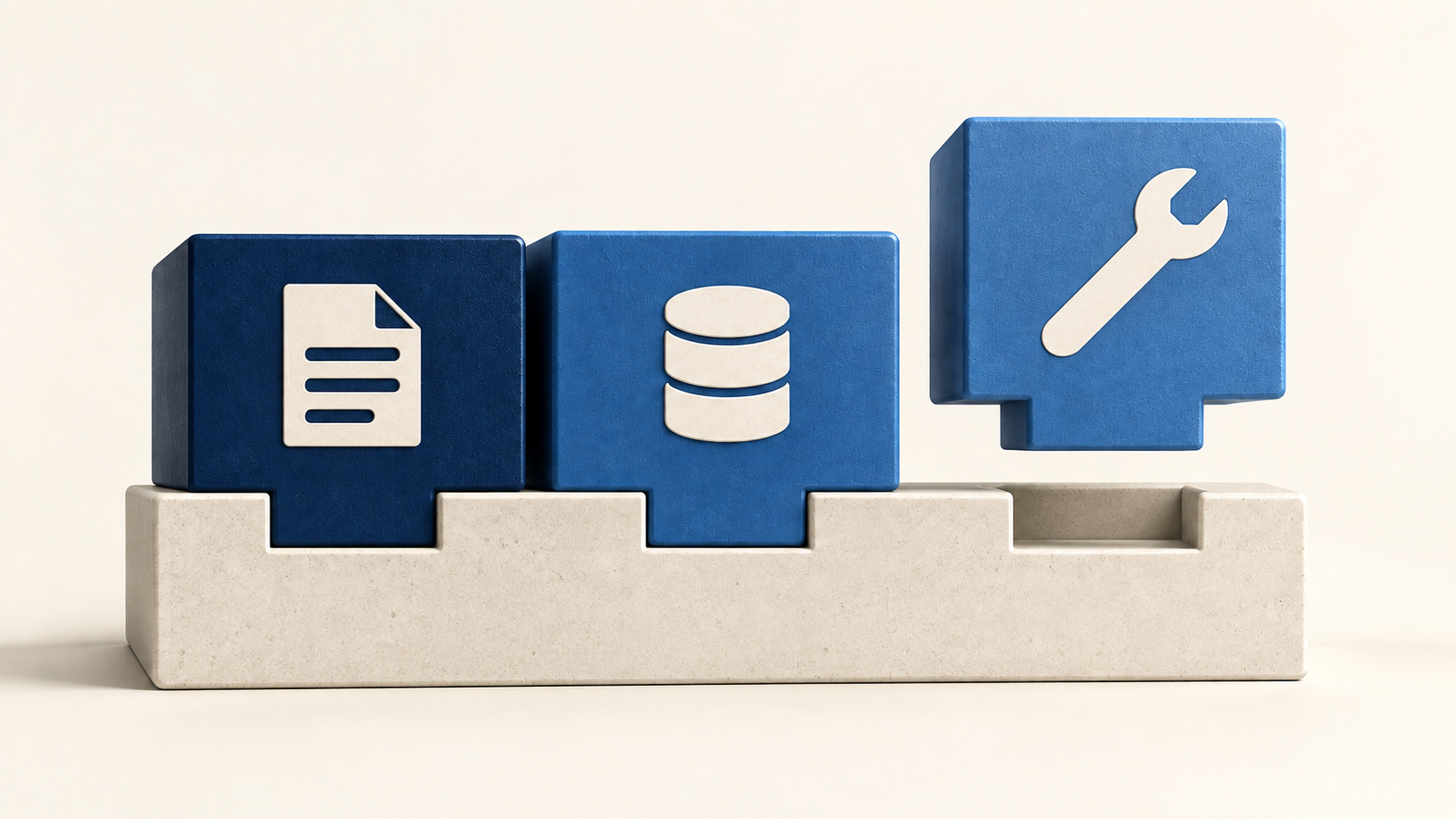
As large language model (LLM) solutions gained popularity, the logical next step was to connect them to other systems to see the possibilities.
Initially, this was a lot of work. There was no standard way for AI applications to connect LLMs with external systems, so each connection had to be wired point-to-point. The follow-on effect was that changing the application or adding another system often meant more integration work.
That was manageable when you had only a couple of applications and systems to connect. But the effort compounded as the number of integrations grew.
November 2024 was a notable turning point. That was when Anthropic open-sourced the Model Context Protocol.
MCP gave the industry a standard way for AI applications to connect with external systems. It did this through three core primitives: tools, resources and prompts.
The result? Integration became easier and faster. Instead of building a separate connector for every client-system combination, you could expose a system’s capabilities through an MCP server and make them available to compatible clients.
December 2025 was another milestone. Anthropic donated MCP to the Agentic AI Foundation, a directed fund under the Linux Foundation co-founded by Anthropic, Block and OpenAI. This moved MCP from Anthropic’s sole stewardship into vendor-neutral governance, although Anthropic remained actively involved in its development.
Rapid growth followed.
Some key figures illustrate the scale:
- By December 2025, MCP SDKs were recording more than 97 million downloads a month.
- A May 2026 pull of the official registry counted 9,652 current server records.
- In July 2026, the specification made its protocol core stateless, making servers easier to run on conventional HTTP infrastructure. It also moved Tasks into an extension for long-running work and strengthened its authorisation model.
MCP was more than an architectural breakthrough. It did more than reduce the time required to connect AI applications with external systems.
It changed the question from:
“How do we get these things to talk to each other?”
To:
“What can we get this end-to-end solution to do now that they’re talking?”
Making it to production
Just because you now have a standard through which AI applications and systems can communicate does not mean MCP servers will automatically make it into production.
Stacklok’s 2026 survey covered 300 senior technical leaders across software, financial services and retail. It found that 41% of organisations had MCP servers in limited or broad production. Among the 100 software-sector respondents, that figure was 45%.
But governance and security have not necessarily kept pace. A separate March 2026 analysis by NimbleBrain found that only 8.5% of the public MCP servers it examined used OAuth. Organisations also face the prospect of shadow MCP servers being stood up without the knowledge of IT or security teams.
So, once you can build MCP servers, you have three things to do next:
- Establish an MCP server registry.
- Define and enforce an audit-defensible identity and authorisation model.
- Make someone accountable for each MCP server.
Sources: Anthropic’s original MCP announcement; Model Context Protocol specification and release posts; Agentic AI Foundation announcement, December 2025; Stacklok, State of Model Context Protocol in Software 2026; NimbleBrain, The State of MCP Security: March 2026.